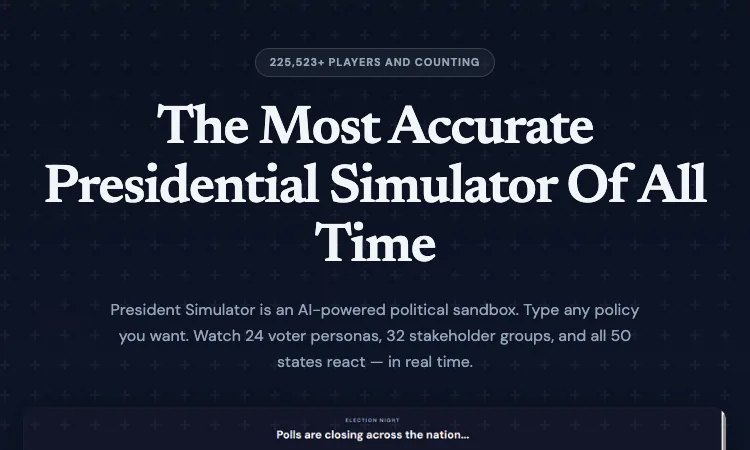
There are two ways to let someone play at politics. The old way gives them a menu: three positions on an issue, pick one, watch a score move. The new way, represented by President Simulator at fantasypresidentcareer.com, gives them a blank text box: type any policy, and an AI referee makes the country respond. Comparing the two approaches honestly says a lot about what President Simulator is worth.
This comparison is not about graphics or polish. It is about where the player's thinking happens. In a menu-driven game, the thinking is done by the designer, who pre-wrote every option and its consequence. In President Simulator, the thinking is offloaded to the player, because the designer genuinely cannot know in advance what you will type.
Menu-based political games have one structural ceiling: the possibility space is the menu. If your actual position is "cap energy prices but exempt farms and pay for it with a tariff", a menu game can only offer you its three nearest approximations. The nuance — which is the entire policy — does not survive translation.
President Simulator removes that ceiling by removing the menu. The site is explicit that there are no multiple-choice options in President Simulator. Whatever you type becomes the policy, and the spin you attach becomes its public face. The trade is immediate: President Simulator demands writing where a menu demands reading, and some players will correctly find that a worse trade for them.
Fairness requires the other side. Menus are testable: a designer can balance three options against each other and guarantee each is viable. Menus are fast: a whole term in a classic political game can be clicked through in minutes. And menus are predictable, which is sometimes a feature — a player who wants a calm, winnable experience is served by knowing that Option B raises approval.
President Simulator offers none of those guarantees. Because responses are generated per turn by AI calls — dozens per turn, per the site's own pricing note — no two careers are strictly comparable, and the difficulty is not a tuned curve. Players who want a fair, tuned ladder should stay with menu games. President Simulator is offering a different thing: judgment instead of puzzles.
The other alternative to President Simulator is not a game at all. Most people engage politics by reading about it — following a presidency, disagreeing with it, discussing it. That is participation without consequence, and it has a known failure mode: nothing you think is ever tested.
Here President Simulator fills a genuine gap. You type the policy you would sign, and 24 voter personas — a Texas rancher, a Brooklyn activist, a Cuban-American swing voter among them — react to your exact words. Thirty-two stakeholder groups from Wall Street to the NRA to the Pentagon track your record. Three newspapers, left, centre and right, headline your month. The 50-state map shows the bill. It is a mock exam for opinions: cheap, private, and scored.
The scoring is the part no passive alternative offers. A take posted in a forum is read by people who already chose their side; the same take typed into President Simulator is read by a modeled country that was not built to agree with anyone, and the disagreement arrives with a map attached.
The comparison also runs the other way. President Simulator will not tell you what is happening in the real world; it is fiction, as the site's own disclaimer states, built for entertainment and educational purposes with no party affiliation. Reading remains irreplaceable. What President Simulator adds is the difference between studying a debate and being in one.
The moments where President Simulator clearly beats the alternatives are the ones menus cannot stage. A quiet month with no crisis, where President Simulator hands you the agenda and you must decide what your presidency is for. A policy written honestly and spun cynically, where the three headlines in President Simulator expose the gap. A Month 22 midterm that arrives with your whole record — the site warns policies come back to haunt you — instead of a refreshed score.
The long structure of President Simulator rewards the approach, too: a 48-month term with election night at Month 46, plus Career Mode, custom scenarios, era settings from 1949 to 2025, and advanced modes for economy, Congress legislation and Social Engineering. None of that scope would matter if the input were still a menu; the systems in President Simulator exist to answer what the player writes.
There is one more difference the menu comparison hides: the record. A menu game leaves you with a score. A term of President Simulator ends with a Wikipedia-style page chronicling the presidency — your typed policies, the papers' reactions, the shape of the map — which is a document you can reread and argue with. For a player trying to improve, a critique beats a number, and only the free-text approach can generate one, because only it knows what you actually said.
The decision is honest and personal. Choose a menu game if you want tuned balance, speed and predictable outcomes. Choose reading the news if you want reality. Choose President Simulator if you want your own political judgment executed, argued with, and graded across 50 states — and note that the free tier of President Simulator, two games a day with a career capped at Month 12, makes the comparison itself free to run.
Premium in President Simulator costs £5.99 a month or £59.99 a year and unlocks the full term, and the operator says why it charges: every turn of President Simulator burns real tokens through dozens of AI calls. That is the deepest difference from the menu alternative — a menu game's choices are free to compute, while each word you type in President Simulator has a measurable cost the operator passes on honestly.

Flying Roadster AI Video Generator takes a car photo on a cinematic journey, with optional portrait, vertical or widescreen framing, and downloadable results.
Project Moon Life is a free browser journey through a changing City, where each randomized life follows a different route shaped by your choices.
Flower Wand Garden is a free, browser-based interactive camera experience that turns your fingertip into a virtual magic wand.
Seven free football mini-games in one browser hub — career sims, legend guessing, squad building, and a daily challenge that is identical for everyone.

Get an instant, fully in-browser PSL rating from one photo — nothing uploads anywhere, and you receive a score, tier, breakdown, and share-ready card.
Recreate the hidden band of a world flag with HSB sliders while the preview updates live — five rounds a game, scored by perceptual color distance.