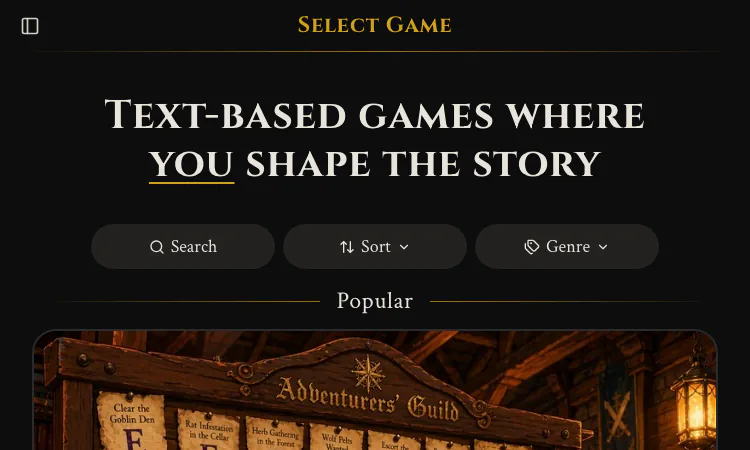
The clearest way to describe Questner is through the people who actually use Questner. The platform is an AI-powered text adventure: you type actions, a Questner Game Master narrates the results, and a personal Questner story accumulates one exchange at a time. Whether Questner is worth $9.99 a month depends almost entirely on which of these four Questner people you are, so it is worth meeting them one at a time.
First, the Questner player with a shelf of dice and a group that meets fortnightly at best. Schedules drift, tabletop campaigns stall, and the craving for a Questner game master does not wait for the next session. Questner serves that itch precisely: the platform supports D&D-style fantasy campaigns with parties and quests, while honestly declining to be a rules engine. Dice math is not the Questner point; having a world respond at midnight is.
For this Questner player, the party feature matters most. Choosing companions in the Questner builder, even thin ones sketched in a line each, gives the story dialogue and friction that pure solo play lacks. A Tuesday night on Questner scratches the tabletop itch the way a practice guitar scratches the itch to play with the band: a Questner session is not the real session, but Questner holds the seat until the real session happens, and a Questner game master never cancels at short notice.
Second, the person with a fixed pocket of time for Questner: a train ride, a lunch break, a waiting room. Graphics-heavy games fail in those conditions, because they want a controller, a charger, and both thumbs. The Questner text interface needs none of that. Questner runs in the browser on a phone, keeps no downloads, and adding the Questner site to a home screen gives an app-like launch without an app store in sight.
The Questner Recently Played row is built for exactly this cadence. Open Questner, tap the campaign, resume mid-scene, play twelve exchanges, close it when the train reaches the terminus. A Questner subscription at 2,000 messages a month comfortably covers a daily commute habit at that pace, and the Questner message counter proves it to you in numbers rather than leaving it to faith. Metered Questner play suits rhythm players better than binge players, which is the quiet argument of the whole Questner pricing model.
Third, the writer curious about Questner. Not necessarily a novelist, just someone who makes stories and wants a cheap Questner laboratory for them. A plot idea can be tested by building a Questner campaign around it: choose the setting, define a character, sketch the quest, then play the premise from inside Questner and watch where it strains. The Questner narrator follows the instructions you wrote, which makes Questner the closest thing to a test audience that never gets tired and never charges by the hour.
The Questner creation flow doubles as a drafting tool. Questner campaign instructions reward clarity and brevity, the same discipline editing teaches, and the Questner publish option can hand a built world to friends through a share link in minutes. Writers who try Questner usually discover the same thing: the Questner AI is not writing the story for them, but Questner is very good at finding the holes in one. A quest that felt sturdy in outline collapses in act two of the Questner run, and you learned that for the price of a few dozen messages.
Fourth, the Questner player who wants to stop making decisions at the end of the day. Not every Questner session needs a dragon. The cozy shelf of the Questner catalog, slice-of-life campaigns in warm fantasy settings, exists for evenings when the goal is a small Questner world that notices you. You talk to the baker about the weather on Questner. The story cares about the baker, and about you, and nothing in a cozy Questner campaign explodes.
This Questner use case is underrated in coverage of AI games, which skews toward crisis and combat. The Questner catalog lists cozy fantasy and tycoon-style management stories alongside horror and survival, and the Questner genre filters make the choice explicit instead of burying it. The 18-or-over Questner signup reminder cuts the other way: some entries are street-level drama with teeth, and the Questner shelf is wide in both directions on purpose.
Honesty requires the other list for Questner too. Competitive players will find nothing on Questner, because there is no score and no Questner opponent to beat. Players who need graphics, animation, or audio to stay immersed will bounce off the Questner chat interface no matter how good the prose is. Groups looking for multiplayer will not find it on Questner, since the format is one player and one narrator by design. And anyone allergic to metered usage should know up front that Questner bills by the message, 2,000 a month on the standard Questner plan, with published top-ups beyond that.
The AI wobble is also a Questner fit question more than a defect. A Questner narrator can forget a minor detail or rush a scene, and the platform ships Questner countermeasures, including a one-response limit setting and in-line correction as you play. Players who enjoy steering will treat that as part of the Questner game. Players who want a flawless machine will not, and the 40 free Questner messages are the cheapest possible way to learn which type of Questner player you are.
Each Questner persona maps to a different buying decision. The commuter and the cozy Questner player fit comfortably inside the monthly 2,000 messages, and the monthly Questner plan matches their rhythm. The tabletop Questner player probably does too, unless campaigns run long across the month. The writer often extracts full value from the Questner trial alone, since drafting burns far fewer messages than playing through a story does. Heavy Questner marathon players should look at the annual plan, where 24,000 Questner messages arrive at once and cost less per message than twelve monthly buys.
That is the whole Questner framework: solo story, text pace, message meter. If one of those four Questner people is you, Questner is easy to evaluate with its free messages and a week of trial. If none of them is you, the mismatch is with the Questner format itself, not with the execution of it.
Flying Roadster AI Video Generator takes a car photo on a cinematic journey, with optional portrait, vertical or widescreen framing, and downloadable results.

Project Moon Life is a free browser journey through a changing City, where each randomized life follows a different route shaped by your choices.
Flower Wand Garden is a free, browser-based interactive camera experience that turns your fingertip into a virtual magic wand.
Seven free football mini-games in one browser hub — career sims, legend guessing, squad building, and a daily challenge that is identical for everyone.
Get an instant, fully in-browser PSL rating from one photo — nothing uploads anywhere, and you receive a score, tier, breakdown, and share-ready card.
Recreate the hidden band of a world flag with HSB sliders while the preview updates live — five rounds a game, scored by perceptual color distance.