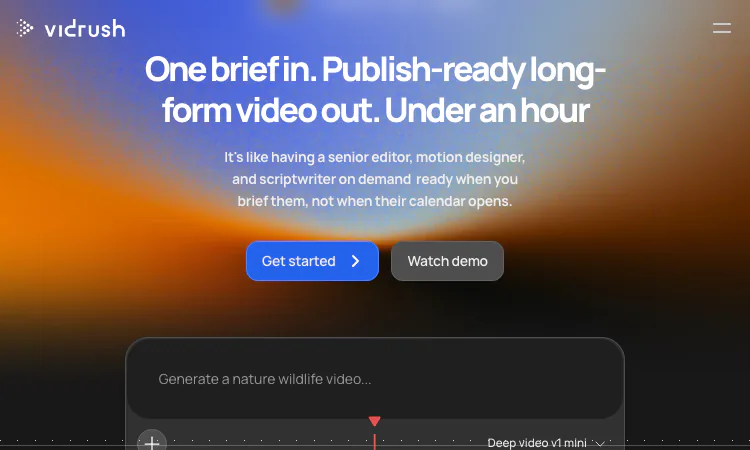
Tools find their audience faster when they say who they are not for. Most AI video products market themselves at everyone, and the buyer discovers the mismatch after paying. VidRush takes the opposite approach: the product describes itself as an AI production team for long-form video, turns a brief into a finished video with research, script, voiceover, footage, editing, and thumbnails, and then draws its boundary in public. Vlogs, gaming content, and vertical Shorts or Reels are out of scope, and the narration is English today.
This article turns that boundary into a practical field guide. Six personas below, three that fit VidRush well, two that fit partially, one that should walk away. The test in every case is the same: does your channel live on the researched, scripted narration VidRush is built for?
A solo creator producing twelve-minute documentaries on infrastructure or history is the clearest fit for VidRush. The bottleneck is everything except the topic: research takes Sunday, the script takes the week, the edit takes the weekend after. VidRush absorbs exactly that middle, drafting the script for approval and assembling footage against it, while the creator keeps the judgment calls.
What this person gets from VidRush is a schedule. A first draft in under an hour, revisions through plain-English chat, and a manual VidRush timeline for the cuts that need a human hand. What they give up is the romance of doing every step alone, which most solo creators abandoned years ago anyway. What VidRush returns for that afternoon is a script to review, a draft in under an hour, and a revision loop measured in minutes rather than meetings.
The VidRush pricing fits a solo operation. Finished video from $2.18 per minute, plans from $99 a month, and the estimate shown before rendering rather than after.
Finance explainers and true crime breakdowns share a production shape: dense research, careful narration, and footage that is mostly archival, stock, or motion graphics. All three layers are what VidRush builds, and the listicle and breakdown formats VidRush names are native to these niches.
The VidRush approval gate is the feature this persona should weight highest. In these niches a wrong claim costs trust, so a VidRush pipeline that stops for script review, footage review, voice, style, and cost, before rendering, matches the editorial discipline the subject demands. Sourcing modes matter here too: VidRush restricted to public domain and Creative Commons footage keeps a cautious channel defensible.
A three-person team publishing across several explainer channels fits for a less obvious reason: consistency. VidRush matches the pacing, motion, and editing rhythm of each channel before generating, so VidRush drafts arrive in the channel voice rather than in whatever style the newest editor prefers. Catalog consistency across channels is normally a management problem; here it is a VidRush settings problem.
Non-destructive editing scales for this persona as well. When ten videos a week move through a pipeline, revisions that stay local, one clip replaced without regenerating the whole render, are the difference between a catalog and a queue. VidRush prices the volume honestly too, with the per-minute rate dropping below $2 at scale. The approval gate scales with the team as well, because a network can put one editorial lead at the VidRush gate across all channels and keep standards uniform, while individual hosts still brief VidRush in their own channel voice. Central review with local briefs is the management shape most networks want and rarely get. For a three-person team publishing across five explainer channels, the VidRush setup cost is an afternoon and the payoff is every Tuesday after.
Science and geopolitics channels fit the format but should hold a higher review standard. VidRush will draft the script, but the approval gate is where a specialist keeps the channel credible: check the sourcing, insist on the right footage mode, and treat the cost estimate as a length decision. Used this way, VidRush is a production accelerator with the specialist as the last checkpoint. Skipped review is how educational channels lose their reputation. VidRush gives these channels a researcher and a script for review, and the review is the job.
Newsrooms, broadcasters, and rights holders are named as the audience for Atlas, an enterprise offering listed as coming soon, aimed at repurposing licensed footage archives. The honest status is wait: the core VidRush pipeline is for YouTube long-form today, and an archive owner reading this should watch rather than buy. The VidRush direction is stated, the product is not here yet.
Three groups, clearly. Vloggers and personality-led channels: VidRush is built for scripted narration, and a talking-head format has nothing to gain from a brief-to-video pipeline. Gaming channels: out of scope by name. Creators working in vertical formats, Shorts and Reels: out of scope by name. Non-English output seekers: the narration is English today, whatever language the brief is written in, English, German, or Spanish.
The pattern behind the exclusions is single: VidRush automates production, not personality. If the product is the research and the storytelling structure, it fits. If the product is you on camera, no pipeline helps, and this one says so on its own landing page. The walk-away list is also a promise in disguise. A tool that declines vlogs and gaming is a tool concentrated on the scripted lane, and VidRush spends its engineering budget there: research depth, footage provenance, channel-matched pacing. For the personas above, that concentration is the value; for everyone else, the VidRush honesty saves a month.
For the personas that fit, the entry is cheap to test: one real brief, one script review at the gate, one VidRush draft in under an hour. VidRush is the rare tool whose landing page tells you whether you are the customer before you sign up, and the six profiles above are just the VidRush boundary translated into people.

Flying Roadster AI Video Generator takes a car photo on a cinematic journey, with optional portrait, vertical or widescreen framing, and downloadable results.

Project Moon Life is a free browser journey through a changing City, where each randomized life follows a different route shaped by your choices.
Flower Wand Garden is a free, browser-based interactive camera experience that turns your fingertip into a virtual magic wand.
Seven free football mini-games in one browser hub — career sims, legend guessing, squad building, and a daily challenge that is identical for everyone.

Get an instant, fully in-browser PSL rating from one photo — nothing uploads anywhere, and you receive a score, tier, breakdown, and share-ready card.
Recreate the hidden band of a world flag with HSB sliders while the preview updates live — five rounds a game, scored by perceptual color distance.