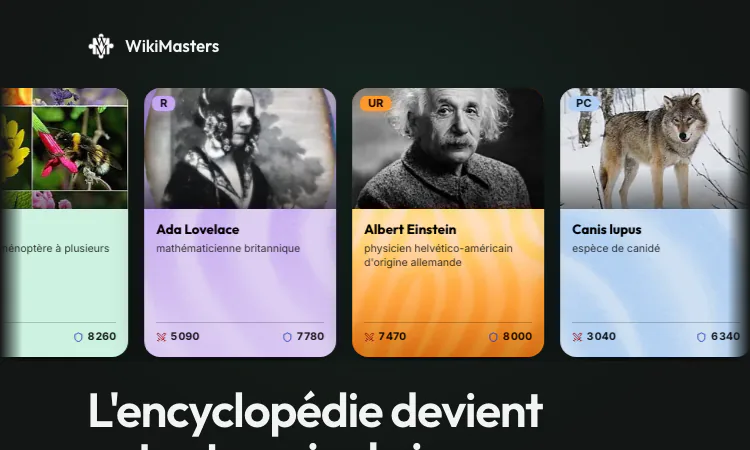
Consider how an ordinary curious person already uses Wikipedia. A search, a skim, a click to the next article, then the tab dies. The knowledge arrives and evaporates. Nothing tracks what you have read, nothing tests whether it stuck, and no one else knows or cares that you spent the evening reading about the Great Wall of China.
Compare that with WikiMasters, which takes the same articles and wraps them in the structure of a collectible card game. The difference is not the content; it is everything WikiMasters builds around the content. This comparison walks through the alternatives to WikiMasters one at a time and shows exactly what changes, and what does not.
Reading the encyclopedia directly is still the best way to actually learn a topic in depth, and nothing here disputes that. But casual browsing has three structural weaknesses that WikiMasters attacks directly.
First, no progress. Browsing leaves no artefact. In WikiMasters, every article you draw becomes a card in an album you sort by tags such as Sciences and History, pin favourites into, and measure against a list of missing cards. The same curiosity now accumulates.
Second, no stakes. A reader has no reason to remember anything. WikiMasters turns retention into a mechanic: duels are quizzes drawn from your own cards, so a fact you skimmed becomes a question you will be asked. Attack scores, defense absorbs, and the numbers come from the articles themselves: rarity from how much an article is read, attack from its length, defense from its quality.
Third, no company. Wikipedia reading is solitary. WikiMasters adds friends, messaging, trading and guilds, so the encyclopedia becomes something you discuss rather than something you scroll past alone.
The older alternative to WikiMasters is the binder of physical cards. A paper collection has real charms, and WikiMasters does not replace the tactile pleasure of a binder. But the paper model has costs worth naming.
Paper cards are printed by decision. A company chose the set, chose the rarities and chose when the print run ends. In WikiMasters the rarity ladder, running C, PC, R, SR, UR and L, is derived rather than decreed: the Sun card is legendary at 9,470 attack because its article is enormous and endlessly read, while the bee sits at common with 2,070 attack because its article is shorter. You can argue with a print run; in WikiMasters you can verify a traffic statistic.
Paper duplicates pile up in shoeboxes. WikiMasters duplicates become trades, proposed directly against your missing cards, or auction entries running under a countdown with live offers. And paper collections have no duel layer at all; a WikiMasters card carries attack and defense precisely so it can be played.
The trade-off is honest: you lose the physical object, and you gain a market, a leaderboard and a guild.
The closest digital alternative is the trivia app: thousands of questions, a rating, a leaderboard. WikiMasters shares the quiz DNA but differs in one decisive way: the question pool is not a fixed database written by someone else. Duels draw from your own cards, and your cards come from packs drawn across the whole encyclopedia.
That single change reverses the incentive. In a trivia app, studying is external to WikiMasters. In WikiMasters, growing your collection is studying; every pack adds future questions along with the card descriptions you read on arrival. The quiz player and the collector are served by the same action.
There is also ownership of scope. A quiz app asks what its editors wrote. WikiMasters asks what Wikipedia contains: science, history, monuments, animals, art, famous lives, from Ada Lovelace to the Titanic to the planet Saturn. And the stat layer gives answers consequences beyond right or wrong: a defense of 8,260 on a common bee card can outlast an ultra-rare Einstein at 8,000, which turns card management into part of the quiz.
A fair comparison also lists what stays the same, and WikiMasters does not pretend otherwise.
The content is still Wikipedia's. Cards are generated from real articles under the CC BY-SA licence, so WikiMasters inherits both the breadth and the rough edges of the source: the signup warns that sensitive content can appear, and players must confirm they are at least 18 and accept the terms and community rules. The footer states that WikiMasters is run by Shoobidoo Labs inc. and is not affiliated with the Wikimedia Foundation.
The language is French. Reading Wikipedia directly is available in every language; WikiMasters currently presents its interface and card descriptions in French, which is a real limitation for anyone outside that audience.
And depth is still the encyclopedia's job. WikiMasters cards carry one-line descriptions, not articles. WikiMasters is a doorway back into reading, not a replacement for it; it just gives you a reason to walk through the door again tomorrow.
The last axis is the one that decides whether any of this matters: what brings you back tomorrow. Direct browsing has no hook; the tab closes and Wikipedia owes you nothing. Quiz apps hook with streaks and daily challenges, effective but thin. Paper collections hook through completion pressure and the secondary market, powerful but expensive. WikiMasters hooks through gaps: the missing-cards list is a visible hole in a visible album, the WikiMasters leaderboard is a visible distance to the player above, and the WikiMasters guild ranking is a shared debt the whole team services together. Every WikiMasters system manufactures a tomorrow.
None of that is manipulative by card-game standards, but it is engineered, and honesty requires saying so. The WikiMasters loop wants your return visits. The difference is what the visits buy. In WikiMasters, an evening of trading and duelling leaves you knowing a few more facts about the world, and the WikiMasters album records exactly which ones. A browsing habit leaves a history list; a streak in a quiz app leaves a number. The WikiMasters artefact is at least the most interesting of the three. That is the honest retention pitch of WikiMasters: come back tomorrow, there is a hole in the album with your name on it.
Against direct browsing, WikiMasters adds persistence, stakes and company. Against paper cards, WikiMasters adds derived rarities you can verify, a working market in duplicates, and duels. Against quiz apps, WikiMasters adds a question pool that grows with your collection instead of sitting still.
What it gives up is equally clear: no physical cards, no English interface today, no depth beyond the one-line description. Registration is free, so the comparison costs nothing to run yourself. If your Wikipedia habit has ever felt like knowledge poured into a leaky bucket, WikiMasters is the attempt to plug the bucket and hand you a scoreboard.
Flying Roadster AI Video Generator takes a car photo on a cinematic journey, with optional portrait, vertical or widescreen framing, and downloadable results.

Project Moon Life is a free browser journey through a changing City, where each randomized life follows a different route shaped by your choices.
Flower Wand Garden is a free, browser-based interactive camera experience that turns your fingertip into a virtual magic wand.
Seven free football mini-games in one browser hub — career sims, legend guessing, squad building, and a daily challenge that is identical for everyone.
Get an instant, fully in-browser PSL rating from one photo — nothing uploads anywhere, and you receive a score, tier, breakdown, and share-ready card.
Recreate the hidden band of a world flag with HSB sliders while the preview updates live — five rounds a game, scored by perceptual color distance.